What are we here for? We are told that we are here to learn a thing or two. We are told that we come to live out our karma that we created in the past. Now why create karma and come back to live it out? If this life that I am living is a result of my past births' karma then what was the very first karma that was a catalyst or initiated my very first birth, and in which plane did it happen? If you need to have done karma to justify taking a birth, then what was the first karma I did and how far back did this take place? I am puzzled. So were we all divine at some time in the past till something took place where we fell from grace?
Isaignani Ilaiyaraja penned a song suggesting that we were in the abode of Shiva and due to our desires took birth here and are now finding our way back home.
Then again it is rather unfair to roll out a series of unfortunate events in this life just to fulfill the law of karma. I am puzzled.
We are captivated by the sacred texts and the teachings of saints and follow suite in prayer that the cycle of birth and death be broken or ends. Holding on to various principle and teachings we work towards achieving the state of deathless-ness. Fine. Then on the other hand we are told that this human birth is rare and that there all countless souls waiting to take birth as humans. I am puzzled.
Now that I am born AGAIN what is it that needs to be achieved? Would not it be nice if we came with specific instructions to perform in this life? Would not it be rather nice if we come with an operating manual too just as some machinery does? But then again that would be a very mechanical and robotic life. Life would not be adventurous. Life will be stale. It is because we have ups and downs in life that it is interesting, otherwise it would be the same routine day in and out and we end up bored.
Only Agathiyar holds the answers to these queries.
For now we have to settle with the understanding that while animals and other living things are here to create balance and harmony in the ecosystem, we have the choice of adding or subtracting things on the face of the earth. We have a choice in contributing towards the welfare of fellow beings and also towards the well being of nature. We are given an opportunity to evolve from an ordinary man to become divine in nature.
Amidst conflicting opinions on whether feeding the homeless is a wise thing to do, where some think that it encourages laziness amidst those receiving the handouts, Ramalinga Adigal established the Satya Dharma Salai in Vadalur and Thavathiru Rengaraja Desigar at Ongkarakudil to feed the unfortunate that goes on till this day. I saw people running to us for food today as I joined Thondu Seivom to hand out buns and drinks purchased with contribution from Amudha Surabhi. I was saddened to look into their faces and tell them that we had run out of buns and drinks. I saw them turn back in disappointment. Thondu Seivom then purchased more buns and went back looking for them only to realize that there we even many more out there waiting for food. We agreed to continue feeding.
Another opinion that was put forward was the question of photographing these moments of giving handouts and posting on blogs and other social medias, that touched on the dignity of those who already have taken a beating in life and ended up on the streets. It was felt that it was unfair and degrading to those on the receiving end to have them photographed receiving aid and have their photos displayed in public. But we needed to document these activities because the money to carry on these activities came from the public.
Besides that we realized that others are mooted and motivated to engage in feeding, watching us do, just as we were motivated by others. Rakesh from Chennai was inspired by charity programs conducted by AVM and AUM's "Pothigai Meals on Wheels", to carry out similar programs in India. He wrote to me, "I do with my office friends and inspired from wheels on meals and AVM". He shares with us how he came to carry out these programs.
"I was sailing through life as usual when a couple of years back I came to know Agathiyar Vanam. I was introduced to many who were engaged in doing service. I thought of doing Anna Dharma too after seeing Agathiyar Vanam Malaysia doing Annadhanam. Last February, with Jeeva Amirtham, Rightmantra Sundar and my office colleagues help (namely Tamilmani, Aravinth, Manikanden, and Mano) we distributed 10 food parcels in and around Guduvancheri. Beginning from March last year, as more friends joined us, we began to do service at Anbu Thondu Illam, Guduvancheri Vallalar Kovil, and Thiruporur Murugan Kovil on a monthly basis. This included cleaning the temples and helping the ashrams. This monthly event finally brought us to plant trees too. This group has now 50 volunteers and we call ourselves Thedal Ulla Thenikal. Looking back we cannot understand how we started. But after a year of involvement, we have come to understood how to live a joyful life through giving to ours. We welcome the public to help us expand our services by extending their contributions and joining us on the ground."
Today, Rakesh and his team at TUT stand humbled serving the community and society exactly in the way that Agathiyar would have wanted. We at AVM are proud of his achievements and are equally proud to associate with TUT in its feeding programmes.
Mrs Kogie dropped in a wish and the following account of her family's humble move to feed the hungry in their home town Johannesburg in South Africa.
Wouldn’t it be great, if regardless of where in the world we resided, we could come together in thought and consciousness to help others. If each of us undertook to do something small in our corner of the world. It could make a huge difference in someone’s life and ultimately have a bigger impact in the world. The size of the initiative is not important. As devotees of Agathiyar we should step forward to do this. Thank you Shan aiya, Bala, Sri Krishna and the many AVM pioneers who have been giving and serving others selflessly. All of you have given me the courage and light to begin the small things in my corner.
Amidst this conflicting opinion, we realized that the homeless were not shy about their fate; neither did they shy away from the camera nor did they snatch away our cameras in disapproval at having their photos taken. We agreed to continue documenting the programme.
Going down to the field with Thondu Seivom and Pothigai Meals on Wheels, I understood why Agathiyar had asked us to continue feeding amidst all the conflicting opinions that prevailed.
Tonight's feeding was in conjunction with Sri Vaanmigar Sitthar's Jayanthi.
Some days earlier Sri Krishna prepared food parcels to be distributed in memory of Dr Jana's late grandfather.
Rekha celebrated her birthday by dishing out food to those on the streets too.
Balachandran too carried out his monthly family contribution of feeding those at a home.
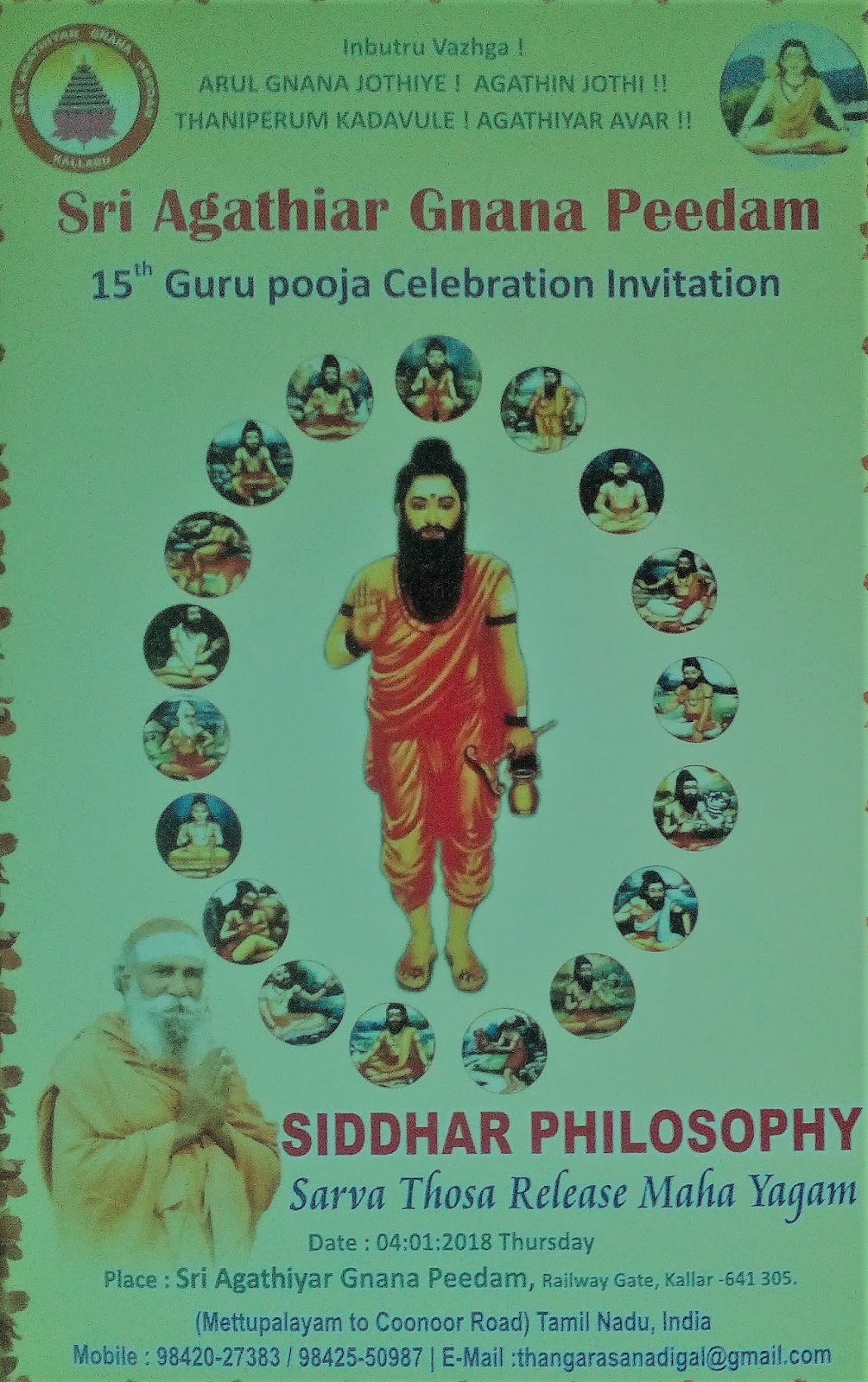
Kallar Ashram is gearing up for the next Guru Puja on 4 January next year. Invitations are out. AVM and SH received the invitations to be distributed to devotees in Malaysia.
Agathiyar came into my life through a Nadi reading. I listened to him. He brought me to where I am today. My family is with me in this worship. Soon he brought a young gentleman over to join in our prayers. He too had a Nadi reading. I was mentioned in it. He brought his friends into this worship. He soon gathered them together to form a group Thondu Seivom, that collected funds among themselves and did service to those in need. In need of a name to identify my home for those seeking directions, I called it Agathiyar Vanam Malaysia (AVM). With the coming together of more devotees of Agathiyar in prayer, we took up service/ charity to the Homes. Hence Amudha Surabhi (AS) was formed to accept and manage the donations that came in for this noble acts of feeding and charity. Soon AVM served the poor on the streets taking the cue from Sri Krishna and his Agathiyar Universal Mission (AUM).
Today we stand humbled that we have been given an opportunity to serve our fellow children of Erai. Although the necessity of carrying out these charitable work was first mooted by Agathiyar in each of our individual Nadi readings, with Agathiyar telling us that it would go a long way towards clearing the backlog of karma that we had carried through several births, the thought of doing it to clear our karma has long since been lost in these service and charity and replaced by joy and fulfillment in giving and sharing. It is interesting how Agathiyar educates us.
I did not have a good impression of street astrologers back then in the 80's asking if they could predict someone's life, promising a bright future, saying rosy and sweet things, why then are they squatting on the 5 foot way? Why are not their lives better? Then there came a time when I took up learning astrologer from the books, the exact reason for picking it up is lost and gone from memory. During the early 90's when the internet was just in its infant stage and there were no online websites or programmes and softwares on astrology, I bought "past year" almanacs and read on how to draft the horoscope from scratch. Only then did I realize the extent of calculations and understanding needed to draw up the chart. Once you have drawn up the chart, you need to have a sound knowledge of this science and all the possibilities and effects or gochara palan of the constellations, stars and planets in constant movement, and an equally good memory. I began to respect the astrologers.
I did not have a good impression of temple priests after seeing a couple of incidents back then in the 80's, and took to doing prayers myself in my home. After a cooling off period of 14 years, I was abruptly awakened to perform and adhere to certain regimes, prayers and rituals at the turn of this century. Agathiyar came into my life, and so did two wonderful Gurus. My life turned Topsy turvy from living a self centered life to that of opening up my life and home to others, moving away from what I thought was important to giving importance to unexpected things that were assigned by the threesome. Bringing me into worship and rituals, although conducting them only once a day, and once a week, I began to realize how it was with the temple priest who did it daily and over several times a day. I began to respect the astrologers.
I was a movie buff and enjoyed listening to songs back then as a youngster. Never did I dream that I would be involved in making an album.
My niece who was a devotee of Sri Raghavendra called to inform me from Kallar ashram that she had just seen the Jeeva Nadi. Agathiyar and Tavayogi had wanted her to produce an audio album carrying songs of praise to Agathiyar. I saw it as a desire and wish from my Gurus.
On returning to Malaysia, she got the composer with whom she had worked in earlier albums under several labels, to work on this album too. The divine work officially started on 29 July. Pre-production began. While the composer got into making the music arrangements, defining artist identity, and preparing the files with tempo/midi, we met up at AVM on 11 August to define the vision and intention, deciding the song list, and a theme for the album. On 12 August I posted news about this forthcoming album and asking for funding, in this blog and our Whatsapp group.
On 3 September, my niece was back at Kallar ashram with the tune for the first track. Amidst the preparation and marketing to be done for the annadhanam during the Pournami Puja on 5 September, Tavayogi took time to come out with the lyrics for the first track. The day she left Kallar ashram with joy in her hearts, another devotee of Agathiyar from AVM arrived at Kallar ashram with her family. The following day as it was a Wednesday, Agathiyar surprised us by revealing in the Jeeva Nadi of the devotee that he was happy with the composition of the song and was glad that my niece had begun the task given to her.
On 20 September my niece met up with us at AVM with the tune for the second track, a lullaby. Thinking and feeling apprehensive whether it would be appropriate to view Agathiyar as a child and sing a lullaby to him, the day after composing the lyrics for this tune, a devotee who participated in the composing, sends me a video clip, mentioning that he had not seen the Tamil movie earlier but the clip was there waiting to be viewed on his computer. To our surprise, in that particular clip, Mother Goddess says to a devotee of hers that she is tired of devotees seeing her as Goddess and wanted to be seen as a child too! So we took it that Agathiyar approved of the song. Amazing. Watch the clip at
Going through the phase of creating a song, writing its lyrics based on a theme and a tune, I began to admire and appreciate more and more the lyricist in the entertainment world. I began to admired the many saints and their devotional works given to mankind so that they too would take the cue and begin their journey towards the Kingdom of Erai.
"God comes to the poor in the form of food.” - Mahatma Gandhi
When Arun Gandhi, the Mahatma’s grandson, speaks of God coming to the poor in the form of food, he is talking about the first obligation of believers in the path of Krishna. Until you feed someone who is poor and hungry, you have not recognized his humanity and he cannot entertain any spiritual aspirations. How can you talk to a man or woman about spiritual matters when they are hungry? When you feed someone with pure intentions you widen your community and add a real reason to feel good about your existence. In Gandhi’s belief, it is Krishna’s divinity that works through you to feed hungry people. Source: http://www.huffingtonpost.com/andrew-blackmore-Dobbyn/holy-kitchens-hinduism_b_856949.html
Agathiyar says that through simple acts of us it brings us relieve from our past karma.
A simple act of feeding the birds, fish, dogs, cows, monkeys and other animals goes a long way in clearing one’s karma.
A simple act of prayer at home, bringing oneself to chant the name of the Deity, Siddha or Erai in any other form, brings countless blessings from them, that helps one sail through the sea of life and overcome its numerous rapids and obstacles.
A simple act of buying someone else food and drinks to ease his hunger and quench his thirst brings merits in multi-fold, that helps offset one's past karma. Agathiyar tells us that the food we serve will turn to medicine and cure the illnesses of those who partake it.
A simple act of performing the fire ritual or Homa has far reaching benefits for the person and the universe too. We understand that lighting the Homa in one’s home brings relieve from sufferings to the entire family, calms and quietens the surroundings and helps prevent major calamities and disasters.
The great masters too have always advised mankind to carry out these small acts of devotion and charity.
Ramana says, "Till you reach the state of jnana and thus wake out of Maya, you must do social service by relieving suffering whenever you see it." Ramana himself is said to love cooking and served the devotees who frequent his ashram.
When Neem Karoli Baba was approached and asked to raise the kundalini, his answer to Ram Dass of "Love Serve Remember Foundation", was simple. "When I asked my guru to raise my kundalini, he said, "feed people." That summarizes the benefits gained in feeding people.
From an excerpt from "The Divine Reality of Sri Baba Neeb Karoli Ji Maharaj" by Ravi Prakash Pande “Rajida” posted on https://www.ramdass.org/mystery-miracles/, we understand that the masters took to feeding the devotees as a priority.
Fewer visitors were coming to Kainchi Ashram, for it was October and getting cold in the hills. One day at about 2 p.m. Kundanlal Sah, an engineer, was going from Ranikhet to his home in Bareilly. On his way he stopped his car at the ashram and went in to have Maharaji’s darshan. There were only four people with Baba. After some time many elderly lady devotees arrived from Nainital, and Baba asked all of them to prepare puris in the kitchen. Sah said that he could not understand why so many ladies would be preparing so much food when there were only four people with Baba and all the inmates of the ashram had already taken prasad. It came to his mind that there must be some other reason for preparing large quantities of puris and vegetables.
At about 7 p.m. two buses full of scouts from Rajasthan arrived unexpectedly at the gates of the temple. They were touring the hills and arrived at the ashram via Dwarahat and Ranikhet. Baba was very happy to see the children and made them eat to their heart’s content.
From another excerpt from the "Near and the Dear" by Dada Mukerjee posted also on https://www.ramdass.org/mystery-miracles/, we realize the inner meaning of feeding.
In a saint, the divine person is encased in the human frame but is not entirely identical. The bottom of the human and the top of the divine stand far apart from each other. There is a co-mingling in the inner space, and in noble human beings, some of the divine qualities merge entirely with their human qualities, destroying all distinction between human and divine. I am saying this about Baba from my own experience of him. I have never seen him wearing his divine crown, but I have always seen his divine qualities of love and compassion. He was always ready and alert to mitigate the sufferings of the helpless by taking their pains upon himself. His body became a honeycomb of diseases. This was the price he had to pay for his compassion and his readiness to help.
Every individual suffers from some kind of physical and mental pain. But with many, hunger or disease of body or mind become acute. One of Babaji’s visible methods of helping people was by feeding the hungry, arranging medical treatment for the sick, and giving money and materials to the helpless. The brief interlude of his life in the ashrams was spent in caring for the hungry and curing the sick, like the head of a household busy with his large family.
Those who visited his ashrams, especially Kainchi, saw how prasad was being served throughout the day to all and sundry without any discrimination. For some it was prasad, an auspicious token of spiritual elevation, but for many more it was a whole meal for the stomach.
Seeing that food was being given in such large amounts, some persons complained that the food was being wasted. Babaji was unrelenting and continued to ask us to give in plenty. “Give more, give more, Dada.” No doubt Babaji would never allow food to be wasted or abused, but his idea of abuse and waste was different from ours, so the bhandara continued, giving food to the needy.
Ram Dass gave me so much loving guidance while we were together on that retreat, and I wanted to pay him back for his kindness. The best way I know to do that is to offer food cooked with love. Anything offered with love is pure medicine, as he has taught me. This lesson is from his guru, Maharaji, who used to say, “Love people, feed people.”
“I feed people with my books and lectures,” he once shared with me.
Agathiyar also extols the benefits in doing charity especially feeding the poor (Annadhanam). We understand in simple terms, that if a person feeds another just once, his (the one fed) life span extends. The person being fed lives to see another day. We are told that by doing charity and feeding others our karma will lessen. We will gain merits. Agathiyar goes further to explain that besides the donors karma having removed or lessen, the karma of the person aided or fed is lessen too by ones charity.
Agathiyar in his revelation to Dr VM Jayapalan during his meditation extols the immense benefits of feeding others. This episode and others were published as an audio CD titled AGATHIYAR THIRUVILAIYADAL by Dr VM Jayapalan of Bangalore.
The Pandit summarizes the Yagna in the following words, "Heal the atmosphere and the healed atmosphere will heal you is the Modus Operandi of a Yagna. In physical terms, Yagna is a process aimed at the refinement of the subtle energy existing in matter with the help of thermal energy of the Mantras."
The Pandit has mentioned findings by some renowned scientists related to the Yagna and provides an extensive list of benefits derived from conducting the Yagna amongst them are:
i. Sublime showers of streams of vital energy from the cosmic layers known as Parjanya, generated by the Yagna, augments the level of Prana in the air.
ii. The Yagna reduces atomic radiation.
iii. Significant changes is observed in the brainwaves and the Anahata Chakra (cardiac plexus) exhibits conditions similar to that which exists after psychic and spiritual healings.
Cle Latouf in his book ‘AGNIHOTRA - AN ANCIENT SOLUTION FOR AGRICULTURE OF THE 21ST CENTURY’ too lists similar benefits of performing the Yagna or Agnihotra and mentions that the ash is used in cleansing drinking water, in irrigation systems, and as a fertilizer.
Cle Latouf and Pandit Shriram Sharma Acharya mention that the smoke from the Yagna is medicinal in value and antibiotic in nature thus eradicating bacteria and micro-organisms providing for a cleaner, purer, healthier environment. Since the offerings placed in the Yagna pit have medicinal properties, they attest that the Yagna is the most effective method of administering these medicines so as to reach every single cell in the body.
Here is a list of various elements offered into a Yagna pit.
ii. Odoriferous Substances. Saffron, musk and camphor.
iii. Foodstuffs. Clarified butter (ghee), milk, fruits and cereals.
iv. Food of a sweet nature. Sugar, raisins, honey.
v. Medicinal Herbs (Names in Tamil). Kunkuma Poo, Aavaaram Poo, Aavaaram Elai, Saaranathi Ver, Vishnu Kranthi, Kasturi Manjal, Valampuri, Yelanthai Palam, Karungkaali, Athimathuram, Nellikaai, Mugil, Ven Kadagu, Thiraviya Pathai, Kadukai, Vilamicha Ver, Korai Kilangu, Vasambu, Kaar pooga Arisi, and Theyvathaaram.
One needs a Yagna Kund/ Kundam to hold the fire and the offerings. A small inverted pyramid shaped copper vessel which is an excellent conductor of electricity and heat is sufficient for performing daily Homam conducted on a personal basis or in a small group.
Cle Latouf states, "The word ‘pyramid’ means ‘fire in the middle’. Because of its inverted pyramid shape, the copper vessel and the Homam performed there in, links are established to the cosmic energy fields. This vessel receives, generates and decentralizes electro sphere besides being an effective anti-microbial reactor. The inverted pyramid shape allows controlled generation and multi-directional dissipation of energy. It acts as a generator of unusual energy fields and spreads them in its surrounding atmosphere.
Among other things Agnihotra has a cleansing effect on air, soil and water and helps to restore the ecological balance. In addition, a harmonization of the human body, soul and mind is possible.
The performance of Agnihotra and application of the resulting highly energetic ashes is called Homa therapy. It follows the central idea: Heal the atmosphere and the healed atmosphere will heal you.
The Agnihotra ash is very rich in minerals and high in energy and can be used in many ways.
And,
Agnihotra is the smallest and basic Homa healing fire which is performed in a copper pyramid of fixed size and shape, tuned to the biorhythm of sunrise/ sunset. It comes from the ancient most Vedic Sciences of Bio-energy, Medicine, Agriculture and Climate Engineering. This knowledge has been revived by Shree Gajanan Maharaj from Akkalkot, Maharashtra last century and taught worldwide by his disciple Shree Vasant Paranjpe.
In this ancient tradition sunrise is described as follows:
“At sunrise the many fires, electricities, ethers and more subtle energies emanating from the sun extend all the way to the Earth and produce a flood effect at those coordinates where the sun is said to rise. It is awesome. The flood enlivens and purifies everything in its path, destroying what is impure in its wake. This torrent of life-sustaining energies causes all life to rejoice. At sunrise that music can be heard. The morning Agnihotra Mantra is the essence of that music. It is the quintessential sound of that flood. At sunset the flood recedes” (Paranjpe 1989).
This post is an extract from my book "FEEDING THE FLAME" revised for the blog.
Yagna: Lighting the Sacrificial Fire
The Siddhas, men who became Divine through performing rituals and severe austerities, realized God and became one with him, knew that not everybody could realize God in themselves immediately. For one to attain Jnana on the onset is a difficult task, so besides tapping into the Akashic records and bringing us Divine revelations; through deliverance of the numerous Scriptures; and drawing up a systematic approach to Yoga and Agamas, the wise men paved the way where one would have to go through the four divisions of Yoga in a orderly manner. The most compassionate Siddhas take us through these four stages, from the most rudimentary and elementary level to the highest level of achievement or attainment of Jnana. The Siddhas devised these paths so that every individual could get on the band-wagon to Godhead and made sure no one was left out of the mainstream.
The first path is Taatamaargam (Sariyai), or Living in the World of Siva, also known as the Path of the Servant. Next is Sarputramaargam (Kriyai) or the Ritual Worship of Siva, known as the Path of the Son. The third path, Sagamaargam (Yogam) or Attaining the Form of Siva, is also known as the Path of Companionship. The final path is Sanmaargam (Jnanam), also known as the True Path.
Keeping alive the sacrificial fire Yagna and performing with ardor the religious acts associated with the sacrificial fire is categorized as the Path of Kriyai.
Yagna: In the Light of the Scriptures
When Tavayogi suggested I carry out the lighting of the sacrificial fire, initially I followed his words with hesitation and reluctance for I was constantly reminded by him before that to leave the Bakthi path and come into the Jnana path. Now why the turnaround, I asked myself? Furthermore I had no idea about these rituals; I was not into rituals then and dreaded doing them. But I did it, since my Guru wanted me. Similarly Agathiyar had other plans for Tavayogi too, postponing his wish to go into Samadhi, instead bringing him to build and manage an Ashram cum temple cum meditation hall and have him conduct rituals as well.
Just as Professor Anil Kumar wrote that in order to experience joy and bliss in this ritual aspect of the activity the inner significance of the ritual or Jnana has to be understood, to bring me to do these rituals with commitment and understanding, Agathiyar clarified to me that it was done for the well being of all, and not for me or my personal gains. Both Professor Anil Kumar and Pandit Shriram Sharma Acharya, too mention that the Yagna is never personal and is for the collective good of mankind.
Professor Anil Kumar provides a clear understanding of the approach needed in conducting rituals, on his webpage www.saiwisdom.com. He explains that there are three aspects to every spiritual activity that is: the ritual aspect of it or Karma; its inner significance or Jnana; and the third, devotion or Bhakti which forms the link between the two.
The Professor says men who conduct the Yagna and the offerings form the Karma Kaandam, or the ritual aspect. He says one needs to have the element of devotion or Bhakti in him to conduct these rituals ‘with sincerity, with steadfastness, with determination, with all its purity and with all the austerities that must go into it’. The path of Bhakti then paves the way for Jnana, and in the words of the Professor, renders ‘wisdom in all humility, in all its reverence because Jnana requires humility, reverence, receptivity, and sensitivity.’ I understood then that I was only a vessel to conduct this ritual.
Pandit Shriram Sharma Acharya in his ‘FORM AND SPIRIT OF VEDIC RITUAL WORSHIP - PROCEDURE OF YAGNA’ reveals that Prajapati or Parameswara created man in his own likeness through a Yagna and ordained that both man and the Yagna had to contribute to the growth of each other, which all the more stresses the necessity of each individual conducting it. From an article on the net, the author (I could not trace the source, but will name him the Author henceforth) too quotes from the Bhagavadgita where Prajapati created human beings and Yagna simultaneously and instructed that they worked together for mutual gain.
The Author explains the Yagna based on his findings in the Vedas, the Puranas and from writings of the Rishis. He equates Yagna as the father of all material and divine or spiritual forces (Ridhi and Siddhi).
The Yajur Veda says Yagna nurtures all and the very Vedas that originated from the Yagna. The Author quotes from the Siva Purana that Yagna is the supreme means to please Lord Siva and as such the Rishis were instructed to come down to earth and perform Yagna for 1000 years. Hence in ancient India it was a practice to conduct massive Yagna by Rishis, Kings and householders. Besides conducting these rituals for material and spiritual gains, certain rituals like the Kaareerishta Yagna was done to create monsoon seasons; Bhaishajya Yagna to eradicate germs and bacteria; Putreshti Yagna to bless childless couples with a child; Balivaishwa Yajna to bring good fortunes to the householder; Vaajpeya Yajna to awaken latent soul forces; and the Rajasuya Yagna to solve problems in politics and governance. According to the Author, as the Gayatri Yagna encompasses all these, the Yagna Yaag Samhita recommends that the Gayatri Yagna be conducted before every auspicious program.
He quotes from more Puranas: the Brihad Narada Purana states that one who performs the Yagna tends to ‘transport’ twenty-one generations before him to Lord Vishnu’s temple; and the Matsya Puraana states that Yagna helps one to attain salvation or Mukti where he/ she shall not take rebirth for thousands and millions of Kalpas.
He quotes Markandeya from the Kalikaa Puraana, the Manu Smriti and Vedas, revealing that the soul in us which is subtle needs subtle food too. The fire in the stomach, Jatharaagni transforms the gross food that we consume into a subtle form which is then imbibed by the soul. Similarly when sacrifices are offered into the Yagna it is consumed by the fire and made subtle. He says the gross fire too becomes subtle in nature. With the aid of subtle wind this then enters the atmosphere and Diu Loka where the Demigods receive their food in subtle form.
‘Prajaapati or world creator is performing Yagna in the form of sun/ moon sending rays to earth, sun sends heat and light, wind circulates life force and a group of Demigods join forces to obstruct ‘demons’ in the form of virus/germs/bacteria from making us ill or warding off imminent death by them.’
The Author mentions the Siddhas who had attained the eight Siddhis and nine Niddhis which included the ability to become invincible, invisible, reducing their size to that of an atom or expanding beyond the world (Vishwarupa), walk on water, and conduct space travel. He says, all these amazing feats were performed using forces of subtle nature termed as Demigods.
The Vedas mention Yagna as a means to fulfill man’s needs and again a means to keep away obstacles on the path of his material and spiritual progress. The Professor says that the Vedas is both Yagna Siddhi and Yagna Sthithi which means ‘to realize the purpose or to fulfill the objectives of every Yagna and the procedural aspects respectively.’
P.V.R. Narasimha Rao in his ‘CHANDI HOMAM - LAGHU PADDHATI’ and www.VedicAstrologer.org too mentions the same,
Most Vedic rituals are symbolic of certain inner changes that you bring about within yourself, to remove obstacles within your Sookshma Sareera that are blocking self-knowledge. The purpose of Veda is the knowledge of self (Aatman) and all rituals are ultimately for that purpose.
P.V.R. Narasimha Rao writes further, mentioning that the Rig Veda equates God as Divine Fire and fire as the Purohita. The Rig Veda recommends the form of fire as an image of God for meditation and devotion. Thus the person conducting the Yagna becomes divine.
‘Such a person’s psyche becomes an unlimited vault of jewels represented by sacred qualities. The Havan doer finds the same in the form of a vault of rare jewels. These are divine jewels of divine wealth which follows us in innumerable incarnations/rebirths that we undergo. They fill us up with so many divine glories (Vibhootees).’
If a spiritually enlightened person recited the Mantras, he creates a spiritually charged atmosphere, which elevates the consciousness of all living beings and harmonizes nature besides awakening the four Vanis: the first and most elementary Vaikhari, the Madhyama type which works in the domain of thought waves, which if refined further, leads to the subtler sounds of Para and Pashyanti, which are described as the Vanis for spiritual communications and conversation with the Brahma. The Author equates these Vanis to: the speech of man, Super Men, Rishis and God.
Pandit Shriram Sharma Acharya says all the rituals and practices, the mind set and feelings, determination and discipline that go into the invocation of the Gods through the Yagna generates a tremendous energy that burns the impurities of our lower nature and transmutes them into good virtues. The Pandit adds, in his words, ‘the collective chanting of Mantras in rhythm produces unique sound waves and vibrations which have an infinite radiant effect in the outer space.’
He explains that one who meditates on God has him come onto the aspirant and receives the mantras and prayers through the internal fire created within. However, this fire is weak in most. So the need for having an external fire arises in the form of the Homam which is a powerful tool for spiritual advancement, aiding and eventually strengthening the internal fire in him.
During the Yagna the fire and the Mantras render the offerings and our thought subtle respectively, which then reach the higher subtle worlds. Chanting of the Mantra awakens certain energies and fire which acts as a vehicle transports these offerings the Demigods. Specific Mantras chanted for specific goals and endeavors result in the creation or manifestation of a specific sound vibration which in turn awakens the divine centers in those gathered at the Yagna establishing a strong bond with the subtle soul which attracts divine powers of the cosmos towards it hence attaining the eight Siddhis and nine Niddhis.
During the Yagna, heat and sound combine to render desired ‘physical, psychological and spiritual benefits.’ The mantra acquires even greater energy when chanted collectively due to the combined vital, mental and causal energies of the masses.
Generally the mantra is in Sanskrit. Cle Latouf quotes a Professor Joshi, ‘it is believed that Sanskrit mantras contain the quintessential sound of life-sustaining energies.’ Just as the Pandit mentioned, Professor Joshi too states that the mantra that create specific vibrational patterns ‘penetrate the energy spheres at the subtle and cosmic levels.’
The Dr explains that Bhootaagni burns in the subtle body which is the very basis of one’s existence. It manifests in the gross body too in various forms of heat and fire. The furnace in the stomach that digest the food; the fire in the brain that makes one analyze and understand all experiences from the senses; and the ever vital body heat that keeps on alive are the result of Bhootaagni. It is weak in most people due to impurities and obstructions in their subtle energy channels or Nadis in the subtle body, thus unable to energize its existence and limiting the entry of the Divine.
He says by overcoming the Malas which are desire (Kaama), anger (Krodha), greed (Lobha), ego (Ahangara), false prestige, wantonness (Mada) and jealousy (Maatsarya), and shedding all veils of delusion (Moha), and strengthening the good virtues, compassion, one-pointed devotion, detachment, eventually the impurities will be cleared and Bhootaagni will burn strong. The Dr adds that this is a very difficult tasks and time-consuming process. He suggests that one take advantage of an external fire to speed up the process.
As the deity of Homam enters the external fire on a regular basis, his divine presence clears the mind off its previous conditioning due to Vasanas where in the words of the Dr., ‘one’s consciousness sinks into the ocean of delusion; strengthens the physical body or gross body (Sthoola Sareera); burns all the impurities in the Nadis in the subtle body or Sookshma Sareera which blocks the free flow of energy; and the karmas in the causal body or Kaarana Sareera and his presence eventually leads to the strengthening of Bhootaagni. Just as the Gods come into the Yagna, the idea is to develop Bhootaagni to accommodate more of the Divine. Then spiritual practices or sadhanas become more effective and give immediate results.
The Dr says, "Homam facilitates this process quickly by burning various karmas that are creating various layers of conditioning and obstructing spiritual progress."
The Dr adds that of the five known elements, earth, water, fire, wind, and ether or space, the only elements that cannot be polluted are space (Akasa) and fire (Agni). Acknowledging that it is difficult to carry out spiritual sadhana through the medium of space he agrees that the best medium would be fire. One of the Sanskrit words for “fire” is “Paavaka”, which means “the one that purifies”. Fire is by definition pure and purifies everything that it comes in touch with. Homam is the most apt sadhana for most spiritual aspirants in this Yuga, especially as the Kali deepens.
Moving from the personal to universal benefits, the Dr. explains,
Apart from the personal benefits, there are universal benefits of Homam. The gross material body of the burnt offerings reaches the gross material body of Sun. The subtle body of the burnt offerings reaches the subtle body of Sun. It is the subtle body of Sun that feeds the subtle bodies of all beings on earth. Thus, feeding it is very important for the smooth running of life on earth.
As we enter the Ghora Kali (terrible age of strife and disorderliness) phase, Adharma (un-righteous activities) will be on the rise in the world and as such the subtle body of Sun will become weaker. If more and more people perform Homam and strengthen the subtle body of Sun, it will balance the adharma and keep the world away from a total collapse.
The Dr advises that one take advantage of the Homam by meditating in front of the fire when the Poornaahuti burns because ‘the chances of losing consciousness of one’s body and immersing in the mantra fully are the maximum at this point of time than any other.’
Yagna: In the Light of the Wise
It is said that God created this world through conducting the Yagna and inspired the Rishis, Siddhas and Munis to continue the heritage of lighting the sacred fire. They viewed Yagna is called the manifest image of the formless Lord Almighty. God was regarded as the personification of Yagna itself.
The Author mentions the significance of lighting the Yagna to the Siddhas, Rishis and Munis. Eternally lit fires in the form of pyres were reinstated in the Ashrams or hermitages of great Rishis of yore. Rishis, through performing the Yagna attained, Sankalpa, resolve and eulogy to God considering fire as an image of God and medium of worship. The Author quotes the Shanti Parva of the Mahabharata where it is mentioned that Vaivamvat Manu and humanity was created at the beginning of Tretaa Yuga. Performing Yagna was the norm during this era. The Author mentions that the Vedas talk of a fire within the material fire which was visual to the Divine Rishis.
The Author says that the spiritual seers and the great Indian Rishis through their subtle divine vision unearthed a science for their manifestation since these energies could not be contacted at the gross level. In his words, ‘they control virtually every aspect of Mother Nature/ Prakriti. Nature’s laws never obstruct their endeavors and hence they carry out acts which are beyond the ken of nature’s laws which seem to be against nature’s laws and impossible to execute.’
He adds that the great Rishis and Siddhas who had succeeded in attaining a supreme spiritual state where man becomes God and the soul becomes Cosmic Soul, gave immense importance to Yagna simply because not only were they means to attain material forces/ powers but that by making man’s body and psyche sacred, desire less and thought free he/ she attained spiritual bliss and peace on an eternal basis.
Dr Pranav Pandya says that the Siddhas, Rishis and Munis, who 'dedicated all their endeavors and all their deeds for the noble mission of enlightening others’, extolled the Yagna too. Warriors were known to perform Yagna before battle. Yogis performed Yagna as part of penance to attain Self Realization and God Realization. He goes on to narrate the achievements of former kings from performing the Yagna,
i. King Dashrathan performed the Putreshti Yajna and thus fathered four sons.
ii. King Nriga entered heaven by performing Yajna and thus dethroned its King Indra.
iii. King Ashwapati performed a Yajna and thus fathered a son.
iv. King Indra of heaven attained all that he possessed via Yajna.
v. Lord Rama too had performed the Ashwamedha Yajna.
vi. Shri Krishna advised the Pandavas to perform the Rajasuya Yajna wherein the Lord himself welcomed guests and looked after their requirements.
Dr. Pranav Pandya writes that one of the foremost Rishis, Maharishi Yagnavalkya besides dwelling in the research of medicinal herbs, was foremost in conducting research and experimenting on the science of Yagna which he did at his ashram in the land of King Janak. The adjacent jungle too provided many sources of plants, scrubs, vegetation and woods for his intensive research. Neither did he stop at that but went on to cultivate various crops that went into the Yagna. He had the inmates of his ashram to participate in the rituals and Yagna for he knew that it would benefit not only them but all of mankind and the entire creation. There was also a place designated to perform Yagna conducted to subdue demonic elements that caused mischief and chose to disrupt the harmony in nature and cause destruction to people and property. Rishi Kathak was responsible for administering this Yagna. Other Rishis like Dirghatama, Kutsa, and Grutsamada too joined MaharshiYagyavalkya in his efforts to maintain law and order in the universe. The significance of the Yagna was explained to all gathered on his ashram grounds.
Dr. Pranav Pandya writes Maharishi Yagnavalkya reveals that there are twenty-one different forms of these Yagna mentioned in Rig-Veda and infinitely many more sub-forms too.
Wood from various trees and herbs with different qualities where used in the sacrificial fire pit to generate ‘different amounts of physical energies (heat)’. Yagna Kundam or kunds of various shapes and sizes were ‘used to conserve and enhance the power of Yagna.’ Recitation of the potentially powerful mantras by the equally elevated aspirant or sadhak and the auspicious moment selected for the Yagna that coincide to utilize fully the prevalent flow of energies of the universe. All these three elements in place, generate a perfect blend of physical and spiritual powers.
Maharishi Yagnavalkya experimented on internal Yagna too just as he did the external Yagna. He says we are similar in form to the Yagna Kundam, having three steps:
i. Mekhlas in the form of mind, and Brahma being its deity,
ii. Prana or life-force, and Vishnu its deity, and
iii. the physical body through its actions represents the benevolent or the destructive form of Siva.
The seemingly ordinary fire of our material world was looked upon them as so extraordinary that great Rishis authored a separate Veda for it in the form of Yajurveda. All this goes only to show that great Indian Rishis had attained knowledge of the subtle most form of fire element.
Yagna: Reviving the Yagna
Professor Anil Kumar explains the three categories of Yagna categorized accordingly to the recipients.
1. The first category of Yagna is for the intellectuals and priestly class, the Brahmins who are committed full time to it, having dedicated their lives to Yagna and whose job is to perform Yagna. This category is further divided into three divisions: Avihavirva Yagna, Soma Yagna and Paaka Yagna.
2. The second category is for rulers and kings. This category is further divided into three divisions: Aswamedha Yagna, Raja Sooya Yagna and Sarvamedha Yagna.
3. The third category is for the rest of us, the householders. This category is further divided into five divisions: Deva Yagna, Rishi Yagna, Pitru Yagna, Manushya Yagna, and Bhutha Yagna. Deva Yagna is an expression of thanks to God for this beautiful gift of life, body, and health. As the Rishis gave us our scriptures, Rishi Yagna is performed to show one's gratefulness for the heritage and legacy, passed on to us through the scriptures. Pitru Yagna is done to express thanks to ones parents. Manushya Yagna implies two things, acquiring good values and serving fellow men. Bhutha Yagna is showing concern for other beings and animals, trees and plants.
P.V.R. Narasimha Rao writes,
My spiritual master Dr Manish Pandit hails from Pune, India and lives in Manchester, UK. The idea of spreading Homam in the world was revealed to him in a dream a few years ago. He saw eight elevated beings in a dream. They transported him across blue skies to Chennai, India, where he was shown the big fire that was to be lighted in future. They told him to start the work. They assured him that Homam as a spiritual sadhana was very appropriate in Kali Yuga. As spiritually inclined people have fewer and fewer hours to spend on spiritual Sadhana everyday with the progressing Kali Yuga, sadhanas that work fast are more relevant. Homam works much faster than Japam and other spiritual sadhanas. They told him that the practice of Homam would transform into a movement that would reach across caste, class and race barriers.’
Dr. Pranav Pandya in ‘YAGYA-SHALA - THE LABORATORY OF RISHIS’ from ‘SCIENTIFIC SPIRITUAL FRAGRANCE OF P.T. SRIRAM SHARMA ACHARYA’ writes, "…Homam is ten times more powerful than Japam. If one does a mantra 1,000 in a Homam, it is equivalent to doing the mantra 10,000 in japam."
True to the words of Dr Manish Pandit, that the practice of Homam would transform into a movement that would reach across caste, class and race barriers, Horst Heigl, author, composer, publisher and initiator and project leader of the Homa-Hof Heiligenberg, Germany, was introduced and told to apply and make this ritual accessible to the public by Shri Vasant Paranjpe in 1974. Horst brought together many people interested in carrying out these Vedic fire techniques, and made a move towards reducing pollution since then, at the Homa-Hof Heiligenberg.
Agnihotra is a fire technique which was already described in the millennia-old Vedas. Through its revival, a remedy was given for numerous problems of our era. Agnihotra makes possible a purification of earth, air and water; it promotes the health of men, animals and plants; it helps to regenerate the psyche, to harmonize the climate and much more. (From the book “Agnihotra - Ursprung, Praxis und Anwendungen” (published by Verlag Horst Heigl; only available in German at the moment). (Source: http://www.homa-hof-heiligenberg.de)
Cle Latouf in his book ‘AGNIHOTRA - AN ANCIENT SOLUTION FOR AGRICULTURE OF THE 21ST CENTURY’ observes that the Yagna if performed at sunrise and sunset and ‘if coordinated correctly, the vital, life sustaining energies of the solar system will be attracted.’ Pandit Shriram Sharma Acharya too observes that it would be ideal if one could conduct a Yagna or Agnihotra twice a day, once at sunrise and again at sunset,
The beneficial effect of sunrise Agnihotra sustains the atmosphere till sunset and the sunset Agnihotra sustains the atmosphere till the sunrise. Synchronizing performance of Agnihotra with these activated moments results in attracting a stream of vital, life sustaining energies of the solar system. Hence the process of Agnihotra which coincides with them plays an important role in harmonizing the natural functioning of human mind and body. In this manner, an unending and active healing cycle is established in the houses where this Agnihotra is performed every day.’,
The Author too ends his article beautifully with a wish that, ‘The tradition of Agnihotra must recommence in every household the world over. There was a time when this did happen in ancient India and hence it was a period of heavenly comforts and inner bliss too. The fruit of Yajna is not comfort but it is attaining more opportunities to serve the world.’
The Sidhas, Rishis and Munis had dedicated their lives towards research and experimenting for the sake of and betterment of mankind and the world at large. Their wives were equally capable and knowledgeable in these related fields. They trained their students in these fields too so that these knowledge and practices would be passed on over the ages to help maintain, nourish and sustain the world and its inhabitants. They were all working for the welfare of the community and people at large. Let us start conducting the Homam in our homes and the Yagam in the temples regularly, doing our small part in building a bond between Mother Earth and us and keeping her harmonized.
According to Siddha writings, Agathiyar was born in the Tamil month of Margazhi when Ahilya Natchathiram was in the 3rd quarter. Agathiyar reveals in the Jeeva Nadi the exact time of his birth as 27 ½ Naaligai or 10 hours 58 minutes after the commencement of Ahilya. Tavayogi Thangarasan Adigal celebrates Agathiyar’s Jayanthi and Guru Puja annually to commemorate the birth (Jayanthi) of Agathiyar, with devotees at his hermitage or ashram in Kallar, Coimbatore, Tamilnadu, India. The highlight of this two day celebration is the lighting of the sacrificial fire or Yagna (Yajna/ Yagam/Agnihotra/ Homam). The next Guru Puja is on 4 January 2018 and again on 18 December 2018.
Tavayogi started performing the Yagna or lighting the sacrificial fire on his ashram grounds some 15 years back, beginning on a small scale that soon led to five numbers of Yagna pits and expanding further to 108 on the directive of Agathiyar and later reverting back to the original number. Tavayogi told me he had embarked on performing the Yagna to calm down Mother Nature hence helping to lessen the natural calamities and as a result saving lives and properties, and healing Mother Earth. Over the years he began to recite mantras and submit various herbs into the fire pit that was to appease the Dosas and to bring fortune and good health upon the devotees.
Tavayogi asked me to conduct the Homam which is Yagna on a smaller scale in Malaysia. Since then I have been performing the Homam in my home with my AVM family and friends every Thursdays, Full Moon, New Moon nights and other auspicious days. I took to perform the Homam during Agathiyar’s Jayanthi and Guru Puja too, simultaneous with the event at Kallar.
When Tavayogi initially mentioned that I do the Homam, I was reluctant as neither was I trained nor did I have the right knowledge to do rituals. He brushed my fear aside and gave me confidence. He told me it was a simple and easy task. As was usual of Tavayogi he did not elaborate much on the procedure and do's and don'ts. I began performing the Homam, accompanied with the chanting of the names of the Siddhas as he had directed. During one of his numerous visits to Malaysia, he stopped over at my home and prepared and conducted the Homam, leaving me to observe and learn the finer points in preparation and lighting the sacred fire. This led me to investigate the reasons for performing / conducting these rituals further.
After going through the books, blogs and websites, I realized the magnitude of the benefits derived in performing the Agnihotra/Yagna/Yagam/Homam. I compiled my findings into a book titled "FEEDING THE FLAME".
Agathiyar in a Nadi reading explained to me, confirming with Tavayogi the reason in conducting this ritual, telling me that it was done for the good of the Prapanjam and all in it. If Tavayogi had initiated me to start lighting the fire of sacrifice in my home, and ignited the fire of devotion in our hearts, taking away the fear of rituals, Agathiyar kept me going relieving me of my initial reluctance in engaging with rituals.
Over the years many devotees picked up this ritual by attending the puja at AVM and have since begun conducting this ritual in their homes too. I am happy that rather than gather weekly at a spot and depend on someone to lead the rituals, the AVM family has picked up enough courage to perform on their own with their family members in the confines and comfort of their homes. In short they have each brought the Siddha Marga into their homes. Tavayogi in his most recent visit to Malaysia last year too was deeply moved and touched by the faith and dedication of the AVM family in carrying out their daily worship independent of any anchorman or middleman.
Rakesh wrote a very inspiring note of thanks sometime back on 28 January 2017. He mentioned that he was inspired by charity programs conducted by AVM and AUM's "Pothigai Meals on Wheels" in Malaysia, to carry out similar programs in India. He wrote, "I do with my office friends and inspired from wheels on meals and AVM". He shares with us how he came to carry out these programs beginning with a recollection of his very first attempt.
"I was sailing through life as usual when a couple of years back I came to know Agathiyar Vanam Malaysia (AVM). I was introduced to many who were engaged in doing service. I thought of doing Anna Dharma too after seeing AVM doing Annadhanam. Last February, with Jeeva Amirtham, Rightmantra Sundar (has since passed away) and my office colleagues help (namely Tamilmani, Aravinth, Manikanden, and Mano) we distributed 10 food parcels in and around Guduvancheri.
Beginning from March last year, as more friends joined us, we began to do service at Anbu Thondu Illam, Guduvancheri Vallalar Kovil, and Thiruporur Murugan Kovil on a monthly basis. This included cleaning the temples and helping the ashrams.
This monthly event finally brought us to plant trees too. This group has now 50 volunteers and we call ourselves Thedal Ulla Thenikal. Looking back we cannot understand how we started. But after a year of involvement, we have come to understood how to live a joyful life through giving to ours. We welcome the public to help us expand our services by extending their contributions and joining us on the ground."
வாழ்க்கை படகில் ஓடிக் கொண்டிருந்தேன். இரு ஆண்டுக்கு முன்பு அகத்தியர் வனம் மலேசியா அறிமுகம் கிடைத்தது. பல்வேறாய் தொண்டு செய்பவர்களுடன் அறிமுகம் கிடைத்தது. அன்ன தர்மம் செய்வது பற்றி நினைத்தேன். அகத்தியர் வனம் மலேசியா குழு அன்னதானம் செய்வதை பார்த்தேன்.
ஜீவ அமிர்தம், rightmantra சுந்தர் என நட்பு வட்டத்தின் அனுபவம் உதவியுடன் என் அலுவலக நண்பர்கள் உதவியுடன் (தமிழ்மணி, அரவிந்த், மணிகண்டன் & மனோ) சென்ற ஆண்டு பிப்ரவரி மாதம் சுமார் 10 உணவு பொட்டலங்கள் தயார் செய்து கூடுவாஞ்சேரி சுற்றி உள்ள பகுதிகளில் கொடுத்தோம்.
மார்ச் மாதம் மேலும் சில நண்பர்கள் கை கோர்த்தனர். அன்பு தொண்டு இல்லம், கூடுவாஞ்சேரி வள்ளலார் கோவில், திருப்போரூர் முருகன் கோவில் என மாதா மாதம் தொண்டு செய்தோம்.
இந்த பணி கோவில் சுத்தம் செய்தல், ஆசிரமத்திற்கு உதவுதல் என நீண்டது. இந்த மாதப் பணியானது மரம் நடு விழாவில் வந்து நிறைந்துள்ளது. தற்போது 50 உறுப்பினர்களுடன் "தேடல் உள்ள தேனீக்களாய்" என்ற பெயருடன் இயங்கி வருகின்றோம்.
எப்படி ஆரம்பித்தோம் என்று புரியவில்லை. ஆனால் ஓராண்டு நிறைவில் மன மகிழ்வுடன் வாழ்தலுக்கான புரிதல் கிடைத்துள்ளது. எங்கள் சேவை விரிவடைய பொருளுதவி செய்யலாம். எங்களுடன் நேரிடையாக பங்கேற்றும் உதவலாம்.
அன்பிற்கும் உண்டோ அடைக்கந் தாழ். நாங்கள் விதைப்பது அன்பு மட்டுமே. வழி நடத்தும் பேராற்றலுக்கு நன்றி,
அக மகிழ்கின்றேன்
அவர் அருளாலே
அவர் தாள் வணங்கி
நன்றி அய்யா.
Today, Rakesh and his team at TUT stand proud serving the community and society exactly in the way that Agathiyar would have wanted. We at AVM are proud of his achievements and are equally proud to associate with TUT in its feeding programs.
Meanwhile, Annadhanam was served at the Eco City Agathiyar temple last night after the monthly Ahilya Natchathiram Guru Puja conducted by Sri Krishna and Balachander Aiya with assistance from devotees.